
The Witness
Incidents of the War of the Rebellion
Tenor, Mezzo-soprano, SSAATTBB Chorus, Piano, String Quartet
Duration: c. 90 minutes
Libretto by Thomas LaVoy, based on Incidents of the War of the Rebellion (1888) by James Waxler
Additional poetry by Walt Whitman
The American Civil War exists in our national consciousness as a vast tapestry of perspectives, the intersection of countless world lines at a pivotal moment in the history of a young, troubled nation. One of these world lines belonged to a young man from Philadelphia named James Waxler, who would join the Union Army when he was underage, fighting first with the 26th Pennsylvania Infantry Regiment in the early moments of the Battle of Gettysburg, and then, more extensively, in the 20th Pennsylvania Volunteer Cavalry until the end of the war. James witnessed a great many things during his time in the army, and ultimately collected his experiences in his 1888 memoir, Incidents of the War of the Rebellion.
This memoir is strikingly honest, displaying James’ unquestionable bravery in tandem with his sometimes-questionable decisions. It is this duality that makes his story so compelling; like all humans, he is imperfect. James unflinchingly tracks his own transformation from a boy seeking the excitement of war to a battle-hardened man, fighting for freedom, in the space of two short years. As his journey takes him into Virginia, he witnesses the inevitable, inescapable horrors of war. His understanding of the plight of the enslaved grows, and he is changed forever when he witnesses the murder of a young slave girl at the hands of a Union soldier.
The Witness: Incidents of the War of the Rebellion strategically incorporates the poetry of Walt Whitman into the story of James Waxler, providing us with an elevated view of the conflict beyond the latter's sight and connecting his world line to the broader story of the Civil War. The work is permeated by three musical themes by composers who were either formerly enslaved themselves or descended from slaves. “The New Death March” was composed by Sawney Freeman (c. 1770s – 1820s) and was rediscovered along with his other transcribed works in the archives of the Watkinson Library at Trinity College in the 2020s (Fig. 1, opposite). “Swing Low, Sweet Chariot,” the well-known and beloved American tune, was composed by Choctaw freedmen Wallace and Minerva Willis (c. 1820 – 1880), likely in the 1860s (Fig. 2, opposite). Finally, a short motive found in "My Lady Love" from Magnolia Suite by Robert Nathaniel Dett (1882 – 1943), chosen for its prime form similarity to that of any three adjacent strings on the instruments of the string quartet, is developed as a musical cell in each movement of The Witness, serving as a foundational element of the sound and affect of the work (Fig. 3-4, opposite).
These three motives represent musical perspectives from before, during, and after the war, respectively – perspectives that would never have come into their eventual forms without the existence of the institution of American slavery, which James and his companions fought so hard to dismantle. In the first seven movements of The Witness, a conspicuous descending third motive is heard repeatedly during moments of tension, loss, and remembrance. It is not until the eighth movement - the murder of the innocent slave girl and the emotional climax of the work - that this motive is plainly revealed to be the first interval of “Swing Low, Sweet Chariot.” This simple melody, interrupted forcefully by the traditional Appalachian tune “O Death,” is sung by the mezzo-soprano soloist, who, until this point in the work, has been silent. This absence bears a dual purpose; James Waxler's own personal revelation in which he finally understands the full scope and horror of the institution of slavery, and, more importantly, the universal understanding that countless world lines were cut short or permanently altered by the very existence of this institution.
The Witness is not intended as a pure history of James Waxler’s involvement in the Civil War, nor is it only a rumination on the evils of slavery. It is a call for each of us to bear witness in our own time; to challenge injustice honestly when we are confronted with it, in whatever form it takes. It is a mirror held up to the face of America, showing us a past that still echoes in the events of our time. Finally, it is a warning in a time of such great national division that talk of another civil conflict is now common discourse. A second American Civil War should be avoided if at all possible; the implications are almost too horrific to imagine.
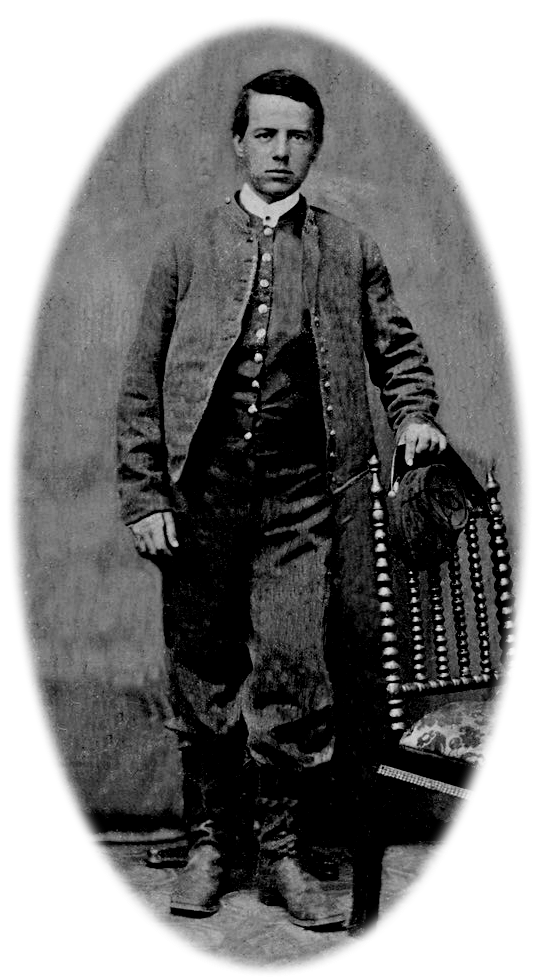
James Waxler, c. 1864